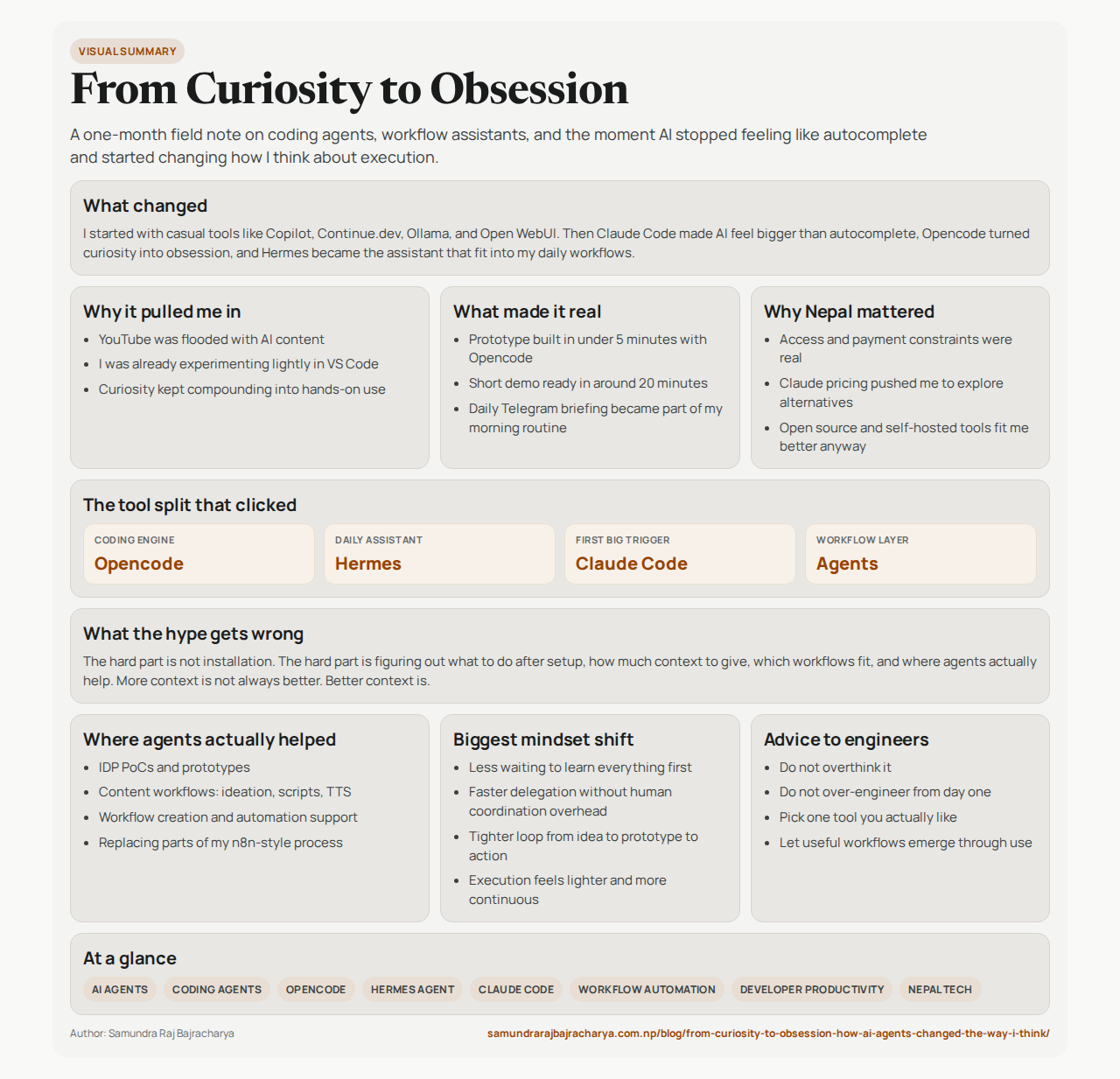
From Curiosity to Obsession: How AI Agents Changed the Way I Think
Over the last month, I fell hard into the AI rabbit hole. It did not start with some grand plan or a carefully written strategy document. It started the way a lot of these things start now: my YouTube timeline kept filling up with AI content, I was already playing a little with Copilot, Continue.dev, Ollama, and Open WebUI, and curiosity slowly turned into obsession. From Nepal, with the usual access, payment, and pricing constraints that come with trying to use some of the best tools, I went deeper anyway, testing coding agents, chasing open-source alternatives, building workflows, breaking things, fixing them, and slowly realizing that AI agents were not just changing how I build, but how I think.
Before the Rabbit Hole
Before I went fully down the rabbit hole, AI was already around the edges of my workflow.
I was using GitHub Copilot and Continue.dev inside VS Code mostly for simple autocompletes and small coding help. I had also played with Ollama and Open WebUI, running smaller local models in a setup that felt a bit like having my own self-hosted ChatGPT. At one point, I even tried Qwen 2.5 Coder in that mix just to see how far I could push the local workflow.
Outside the editor, AI had already started sneaking into some of my automation work too. I was using n8n for things like VM creation workflows and parts of my blog pipeline, and AI was showing up there in small but useful ways, helping with idea generation, research, and similar support tasks.
But even then, AI still felt like an accessory. Useful, interesting, sometimes impressive, but still sitting beside my actual workflow rather than becoming part of how I thought about building things. That changed very quickly.
The First Tool That Made It Feel Different
The first tool that made me feel like this was bigger than autocomplete was Claude Code.
Until then, AI still felt like a useful layer on top of what I was already doing. Claude Code felt different. It made me feel like I was no longer just getting suggestions inside an editor. I was starting to work with something that could actually participate in the flow of building.
That also came with a very real problem: it worked best with Claude, and from Nepal that immediately brought up the usual friction around access, payment, and cost. I could see the potential, but I also knew I could not just throw money at the problem and move on.
So I did what I usually do when I hit that kind of wall: I started looking for open-source and self-hosted alternatives. That mattered more than I expected. It pushed me away from just consuming the shiny default option and into understanding the broader ecosystem. In a weird way, the constraint was useful. It forced me to explore, compare, experiment, and eventually find tools that fit me better.
From Curiosity to Obsession
That search led me to Opencode, and that was probably the point where curiosity turned into obsession.
At first, I was just happy to find something open and usable. I tried the free models it supported, then connected it to OpenRouter, and for a while I even got to enjoy Qwen 3.6 Plus when it was temporarily free. That only made things worse in the best possible way. Once I saw what was possible, I started trying to use it for everything.
For a few weeks, I was obsessed. Every time I had an idea, a task, or even a random curiosity, my first instinct was to see if I could push it through Opencode. It stopped being a tool I was testing and started becoming part of how I explored problems.
Around the same time, I also looked at OpenClaw because everyone seemed to be going crazy about it. I tried to get it set up, but that one never really clicked for me. That became a pattern I kept noticing: there is always another tool, another setup, another wave of hype. Not all of them actually become part of your workflow.
Then I found Hermes Agent.
That felt different almost immediately. If Opencode felt like a coding engineer sitting beside me, Hermes felt like a real assistant. Not just for code, but for workflows, automation, research, summaries, and all the little things that pile up around actual work. Opencode made me excited about coding agents. Hermes made me start imagining what it would look like to have my own Jarvis.
The Moments Where It Clicked
There were a few moments where this stopped feeling like experimentation and started feeling real.
The first was with Opencode. One of my colleagues suggested we build something, and I remember thinking, okay, I just set this thing up, let me try it. Then boom, a prototype was ready in less than five minutes. I cleaned up a few bugs, and within around twenty minutes I was already giving a short demo. That kind of speed changes your relationship with ideas. You stop treating them like future work and start testing them immediately.
The second was much more personal. I was getting burned out trying to keep up with everything happening across AI, cloud, and tech. There was just too much noise, too many tabs, too many things to track. So I asked Hermes to compile the important updates and send them to my Telegram in an organized format. Now it shows up every day, and honestly, it makes me smile. It became part of my morning routine. That may sound like a small thing, but that is exactly the point. The magic was not just in big demos. It was in becoming useful enough to quietly fit into daily life.
The third was when I connected ChatGPT to Hermes. I still do not fully know how to explain that one. Something about the combination just worked. Maybe it was the continuity, maybe it was the memory, maybe it was just a better flow between systems. I cannot explain the internals, but I can explain the feeling: it was scarily good.
Those were the moments when I stopped seeing AI agents as interesting tools and started seeing them as part of my environment.
What the Hype Gets Wrong
Of course, the rabbit hole was not all magic.
One thing I realized very quickly is that setup is only the beginning. There are plenty of guides that show you how to install a tool, connect a model, or get the UI running. What is much harder to find is guidance on what to do after that. How should you actually use the tool? How much context should you give it? What kinds of workflows fit it well? What should stay manual? Those are the questions that matter, and they are usually the part you have to figure out yourself.
I learned that the hard way with my first Hermes setup. I made the classic mistake of overloading it with too much information about me, too many instructions, too much detail about what I wanted, and too much detail about how it should behave. Instead of making it smarter, I basically broke it. It started hallucinating, getting stuck in tool loops, and producing garbage. That was one of the first times I realized that more context is not always better. Better context is.
I also think a lot of the AI world is overhyped in the wrong direction. People love showing the biggest, flashiest, most dramatic things agents can do. But most of those were never the reason I cared. I was not looking for an agent to impress me on a stage. I wanted something that could fit into my actual life and actual work.
That was the real lesson: the important question is not, "What huge thing can this do?" The important question is, "Which of my workflows should this help with?" Once I started thinking that way, the noise mattered less and the useful parts became much clearer.
Where Agents Became Actually Useful
Once I stopped chasing hype and started looking at my real workflows, the usefulness became obvious.
A lot of my day-to-day work is around internal developer platforms, so I spend a lot of time building PoCs, prototypes, and systems that need to move from idea to demo quickly. That kind of work turned out to be a natural fit for agents. They are incredibly useful when you are exploring, scaffolding, comparing approaches, or trying to compress the time between "this might work" and "here is a working version."
I was also building systems around content creation workflows, things like ideation, script writing, and text-to-speech, and AI was not just part of the product there, it was also part of how I built the product. That made the whole thing even more recursive in a fun way.
Hermes became especially useful because it was not limited to one narrow role. It helped me create workflows, refine them, automate pieces of them, and in many cases absorb tasks that I might previously have pushed into n8n. Some of my n8n workflows are still there, of course, but a lot of the workflow thinking itself started getting delegated to Hermes too.
And some of the most useful workflows were not even the flashy ones. A daily tech, cloud, and AI briefing. An end-of-day summary of what I got done. Small helpers for staying organized, reducing noise, and keeping momentum. That is probably the biggest thing people miss when they talk about agents. The value often does not come from one giant magical workflow. It comes from a pile of smaller ones that quietly make your day better.
The Real Shift in How I Think
The biggest change was not really about tooling. It was about how I think about execution.
For a long time, I carried a line from one of my mentors in my head: when I have an idea and I want to do it, I do not stop. If I can execute it, I do it. If I need to learn a new skill, I learn it. If it is too difficult to do alone, I find help. I have always loved that philosophy, but in practice I kept getting trapped in the same loop: if I need to learn a new skill, then I will. And then I would keep learning, and learning, and learning, while the idea sat there waiting.
That was always the bottleneck. Not lack of interest. Not lack of ideas. Not even lack of willingness to work. It was the gap between having an idea and having enough time, knowledge, and bandwidth to move on it fast.
Even delegating small research tasks to people never felt very efficient to me. Before they could help, I had to explain the idea, explain the context, explain what I already knew, wait for the results, and then merge everything back into my own mental model anyway. Sometimes the coordination cost felt almost as heavy as doing the work myself.
That is where AI agents changed something fundamental for me. They gave me a way to delegate without the same overhead. Not perfectly, of course. They still need direction, context, and correction. But the loop is much tighter. I can stay in motion. I can keep momentum. I can move from idea to prototype, from confusion to research, from overload to structure, without feeling like every step requires a full context switch.
That is why this month felt bigger than just discovering a few cool tools. It changed how I think about learning, delegation, and execution. For someone who cannot just hire a team every time an idea gets interesting, that shift feels enormous.
What I’d Tell Other Engineers
If I had to give one piece of advice to other engineers getting into agents, it would be this: do not overthink it.
Do not start by trying to design the perfect setup, the perfect memory system, the perfect prompts, the perfect toolchain, and the perfect workflow map all at once. That instinct is understandable, especially if you are technical, but it can actually make the whole experience worse.
I think it is better to start with a blank slate. Pick one tool you actually enjoy using, Claude Code, Opencode, Codex, whatever fits you, and just begin. Add one or two skills or workflows as you go. Let the system become useful through use instead of trying to fully architect it before it has earned that complexity.
That was one of the biggest lessons for me. Agents get better when the relationship gets better. You learn how to operate them, and they slowly become more aligned with how you think and work. If you try to force all of that upfront, you can end up with something more fragile, more confusing, and less useful than a much simpler setup.
Premature complexity is not a sign of maturity here. Most of the time, it is friction in disguise.
Final Thoughts
I do not feel like I reached the end of anything over this last month. If anything, I feel like I only found the entrance.
What started as curiosity turned into obsession, then into daily use, and then into a real shift in how I think about work, learning, and execution. Some of it is hype. Some of it is messy. Some of it still breaks in strange and annoying ways. But enough of it is real that I cannot look at the way I used to work the same way anymore.
And the truth is, I still feel like I am falling deeper.