👋 Hey Fellow Tech Explorers!
If you've been following my journey, you know I love squeezing every drop of potential out of my hardware. But lately, it's impossible to talk about hardware or homelabbing without addressing the 800-pound gorilla in the room: Artificial Intelligence.
We've moved past the "is it a fad?" phase. AI is here, it's powerful, and depending on where you look, it's either a superpower, a headache, or a massive hit to your project budgets. Let's break down the landscape as I see it from my digital playground.
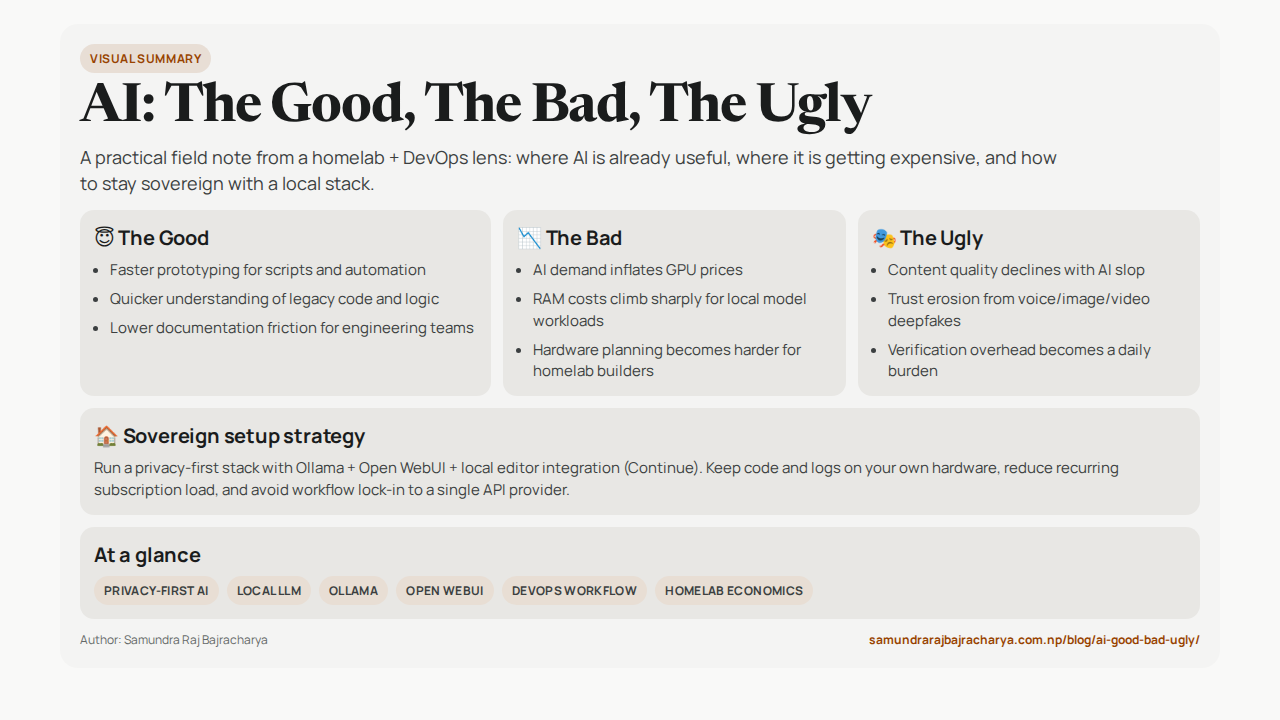
😇 The Good: The Coder's Superpower
As someone who has navigated everything from support helpdesks to DevOps, I can tell you: Generative AI is a game-changer for workflow. Remember the days of scouring StackOverflow for hours just to find a regex pattern or a specific Bash syntax? Now, AI acts like a pair-programmer that never gets tired. It's not about letting the AI "do the job" for you—it's about removing the friction.
- Faster Prototyping: Turning an idea into a boilerplate script in seconds.
- Explaining Legacy Code: Feeding a confusing script into a model and having it explain the logic back to you.
- Documentation: Let's be honest, none of us love writing docs. AI makes it painless.
📉 The Bad: The "AI Tax"
Now, for the part that really stings for us hardware nerds: The soaring cost of entry. A few months ago, you could pick up parts for a decent virtualization node without breaking the bank. Today? The "AI Gold Rush" has filtered down to the consumer market in the worst way possible.
- GPU Hunger: Because everyone wants to run local LLMs, even mid-range consumer GPUs are being snatched up, keeping prices artificially high.
- The RAM Crisis: This is the real kicker. Since large models need massive amounts of memory to run smoothly, RAM prices have skyrocketed 3-4x in just the last few months. What used to be a cheap 32GB upgrade is now a major investment.
🎭 The Ugly: Content Chaos
While we're using AI to build, others are using it to blur the lines of reality. We've entered an era of Content Chaos.
From AI-generated voices that can mimic a loved one to deepfake videos and hyper-realistic images, the "Ugly" isn't necessarily the tech itself, but how fast it's outpaced our ability to verify what's real.
- Information Overload: The internet is being flooded with "slop" - low-effort, AI-generated articles and videos.
- Trust Erosion: When anything can be faked, everything becomes suspicious. Trust is becoming the most expensive commodity online.
🧐 The Struggle: The Problem with "Cloud AI"
Before I share my setup, let's talk about why the standard way of using AI (ChatGPT, Claude, Copilot) is becoming a problem for people like us:
- The Privacy Black Box: When you paste your code or logs into a cloud AI, you're essentially handing your data over to a giant corporation. For a privacy-conscious homelabber, that's a hard pill to swallow.
- The Subscription Trap: $20/month here, $10/month there... it adds up. I'd rather put that money toward physical hardware I can keep.
- Dependency: If the cloud provider goes down, or changes their terms of service, your workflow breaks. We spend our lives building redundant systems at home—why rely on a single API for our intelligence?
🏠 My Strategy: The Sovereign Homelab Approach
You know me—I'm not one to just hand over my data (and my monthly fees) to Big Tech if I can help it. I've built a "Privacy-First" AI stack that solves these issues by keeping everything local.
🛠️ My Local AI Stack:
- Ollama: The powerhouse that lets me run LLMs locally without needing a PhD in data science. It's the engine under the hood.
- Open WebUI: For that slick, ChatGPT-like interface that runs in my browser. No more clunky terminal prompts for general chat.
- VSCode + Continue.dev: I've officially swapped out GitHub Copilot for local models. It integrates directly into my editor.
- The Model of Choice: Qwen2.5-Code-7B. It's small, fast, and punches way above its weight class for Python and Bash scripting.
Why this works for me:
- Privacy: My code stays on my storage, not on a corporate server.
- Cost: Zero subscription fees. My only "subscription" is my electricity bill!
- Independence: My lab, my rules. I don't care if a provider's API goes down.
🔮 Final Thoughts
AI is a tool, much like the hypervisors and containers we've talked about before. It can be a chaotic force, but if you take the time to host it yourself and understand its limits, it becomes an incredible asset to your technical toolkit.
The hardware prices are a bitter pill to swallow, but the "Good" you can do with a small, local model like Qwen is only getting better.
What's your take? Are you paying the "AI Tax" for new hardware, or are you waiting for the bubble to pop?
#AI #HomeLab #Ollama #SelfHosted #Qwen #DevOps #TechLife #GPU